
Templates Community /
Spring MVC Incident Management System Architecture Diagram with Three Tier Layered Structure
Spring MVC Incident Management System Architecture Diagram with Three Tier Layered Structure

Satyarth Shukla
Published on 2022-07-11

 Desktop

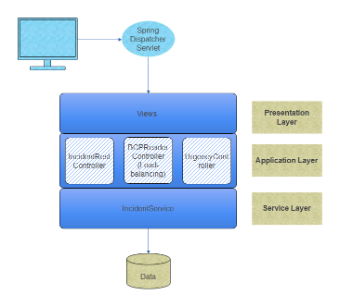
This comprehensive technical system architecture schematic illustrates the complete layered design of a Spring MVC-based incident management application, a critical enterprise IT service management system. The diagram visualizes the end-to-end request flow, component roles, and layered architecture from client frontend to database storage, following the standard Spring Web MVC pattern with explicit separation of presentation, application, and service layers, making it an essential reference for Java developers and system architects.
The architecture is structured into three core logical layers, aligned with the right-side legend:
Presentation Layer: The client-facing entry point, consisting of:
Client computer: End user access device sending HTTP requests.
Spring Dispatcher Servlet: The central front controller in Spring MVC, responsible for routing all incoming requests to the appropriate controllers.
Views: The frontend presentation layer, rendering responses back to the client.
Application Layer: The controller tier, housing the application’s request-handling components:
IncidentRestController: REST API controller for incident management operations.
BCPReader Controller (Load-balancing): Load-balanced controller for BCP (Business Continuity Plan) data reading operations.
UrgencyController: Controller for urgency/ priority management of incidents.
Service Layer: The business logic and data access tier, consisting of:
IncidentService: The central service layer component, encapsulating business logic, coordinating controller requests, and managing data operations.
Data: The backend database storage system, persisting incident records, service data, and application state.
This fully layered, MVC-compliant architecture ensures separation of concerns, modularity, and scalability for enterprise incident management systems, with built-in load balancing for high availability.
This type of Spring MVC system architecture diagram is ideal for Java Spring developers, system architects, enterprise IT developers, DevOps engineers, application designers, and computer science students. It is an essential tool in multiple scenarios: incident management system design, Spring Web application architecture documentation, project presentations for enterprise IT, technical training for Spring developers, database integration design for Spring applications, and service-oriented architecture implementation.
The diagram combines a clear hierarchical structure, standardized Spring MVC symbols, explicit request flow paths, and layer separation, making it accessible for both expert Java developers and project stakeholders. It enables quick visualization of the entire application’s request routing, component roles, layered structure, and data flow, ensuring reliable, scalable, and maintainable operation of the incident management system.
Tag
Spring Dispatcher Servlet architecture diagram
three tier Spring Web application schematic
Spring MVC incident management system architecture diagram
Share
Report
0
49

Post
Recommended Templates
Loading
