
Templates Community /
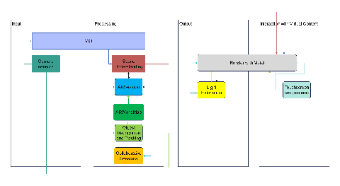
ARKit System Architecture Diagram
ARKit System Architecture Diagram

Rohan Daniel
Published on 2023-08-06

 Desktop

Interactions between Components:
Visual Inertial Odometry (VIO) System:
Interaction with the device's camera and inertial sensors to track real-time movement.
Provides tracking data to the ARSession for accurate positioning of virtual content.
ARSession:
Orchestrates and coordinates various components (VIO, Scene Understanding, Rendering, ARWorldMap, Object Recognition and Tracking, Collaborative Sessions) to create the AR experience.
Receives and processes camera frames and motion data from VIO for pose estimation and motion tracking.
Communicates with Scene Understanding to gain an understanding of the user's environment and detect surfaces and objects.
Communicates with Rendering for displaying virtual content on the device's screen.
Utilizes ARWorldMap for persistent AR experiences, allowing users to revisit virtual content across multiple sessions.
Collaborates with Object Recognition and Tracking for detecting and tracking specific objects in the real world.
Facilitates Collaborative Sessions to enable multiple devices to interact with shared virtual content in the same physical environment.
Scene Understanding:
Analyzes the physical environment by utilizing environmental mapping and feature detection.
Provides information about flat surfaces, objects, and 3D geometry to ARSession for content placement.
Rendering with Metal:
Receives information from the ARSession about virtual content and its position.
Uses Metal's low-level graphics API to efficiently render virtual objects with high visual fidelity.
Utilizes information from Light Estimation for realistic lighting effects.
ARWorldMap:
Facilitates persistent AR experiences by saving and sharing representations of the user's environment across multiple sessions.
Enables AR content to be consistently anchored in the same physical locations across different sessions.
Light Estimation:
Estimates the ambient lighting conditions in the environment using data from the device's camera.
Provides lighting information to Rendering for adjusting the lighting of virtual objects.
Object Recognition and Tracking:
Empowers ARKit with the capability to detect and track specific objects in the real world.
Enables interaction with virtual content based on recognized real-world objects.
Collaborative Sessions:
Allows multiple devices to share and interact with the same virtual content in a shared physical environment.
Supports real-time collaboration and social interactions in AR applications.
Boundaries:
Input:
The camera and inertial sensors provide real-time input data to the VIO system for motion tracking.
ARKit receives data from the device's camera and sensors to perform scene understanding and render virtual content.
Processing:
VIO processes camera frames and motion data to estimate the device's movement and orientation.
Scene Understanding analyzes environmental mapping and feature detection data to understand the physical space.
ARSession coordinates the processing of data from VIO, Scene Understanding, Rendering, ARWorldMap, Object Recognition and Tracking, and Collaborative Sessions to create an interactive AR experience.
Output:
ARKit outputs the AR experience by rendering virtual content onto the device's screen.
Rendering generates visually realistic virtual objects with accurate lighting effects.
Interaction with Virtual Content:
Users interact with virtual content displayed on the device's screen through touch and gestures.
ARKit uses tracking data from VIO, Object Recognition and Tracking, and information from Scene Understanding to anchor virtual objects to specific locations in the real world.
Tag
architecture diagram
ARKit System
Share
Report
1
36

Post
Recommended Templates
Loading
